

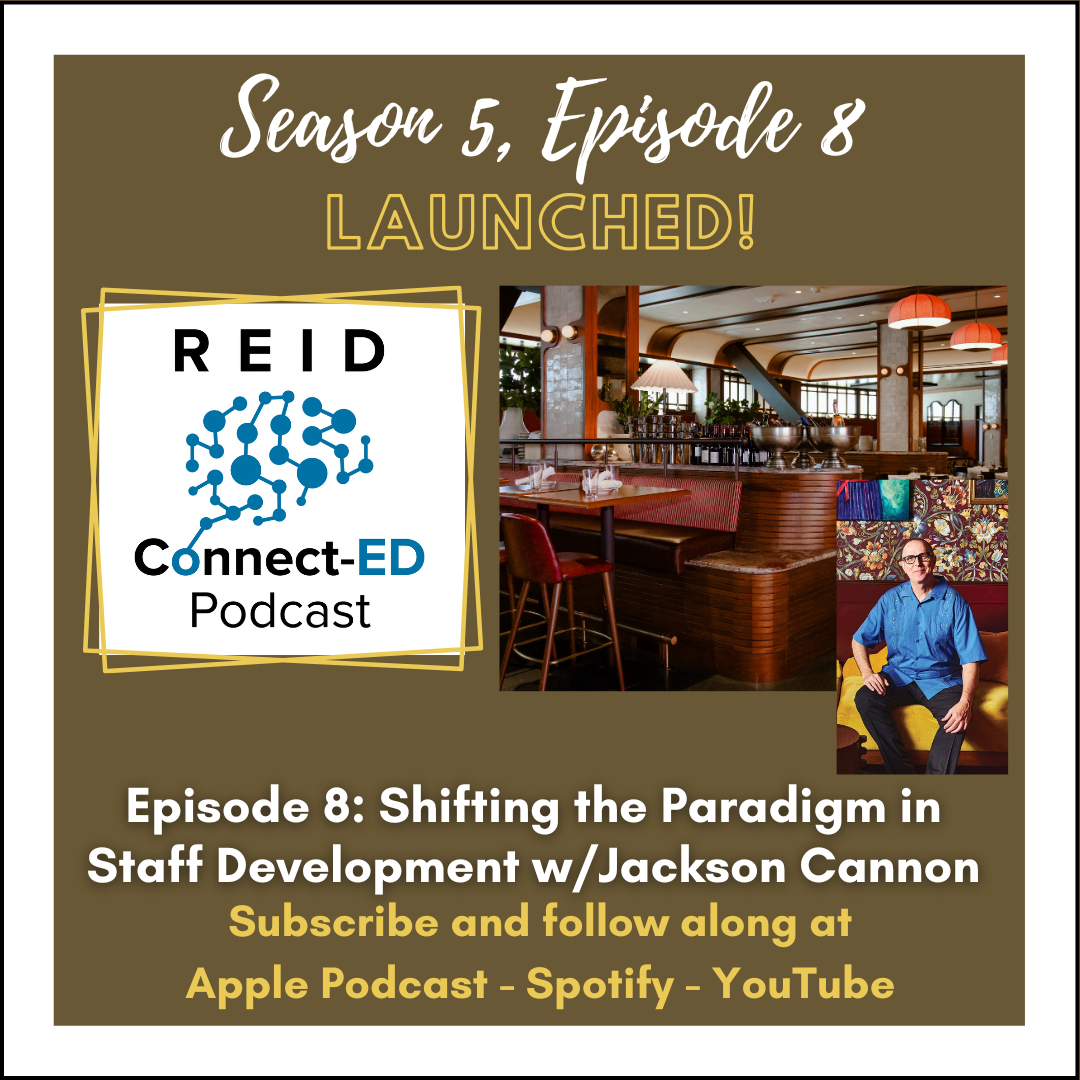
S5 E8: Shifting the Paradigm in Staff Development w/Jackson Cannon
Listen Now!
-
https://www.easternstandardboston.com/
Jackson's Bio: Son and brother of renowned award-winning journalists Lou and Carl Cannon, Jackson grew up immersed in a world of travel, politics, and literature. In his twenties Jackson dedicated himself to a career in music, traveling the world in support of such dynamic acts as Eddie Kirkland, Gatemouth Brown, Dennis Brennan, and The Tarbox Ramblers. A stint booking music acts at the Lizard Lounge in Cambridge, Massachusetts provided the fortuitous introduction that took him all the way to settling in Boston, transitioning out of music, and ultimately taking on a management role of Boston's renowned Eastern Standard Restaurant (in the heart of Fenway, next to Fenway Park), owned by Garrett Harker. Garrett's depth of experience, knowledge, and wisdom shines through in this episode. @CannonJacksMore about Jackson
-
It can help workers and managers to operate from the assumption that everyone learns better with multiple modes of teaching something - showing, explaining, visualizing, modeling, etc. - rather than assuming one way of teaching is going to work for everyone.
Sometimes individuals who have challenges in traditional settings like in a classroom or office may thrive in the service industry, as their strengths can shine, be acknowledged, and be utilized in a way that fits them well.
It can help individuals with learning challenges to not operate from a place of shame, which can be fostered by managers who are understanding and seek to collaborate around what works best for them to thrive in the work and learning environment.
The interpersonal environment of the service industry may reflect society as a whole; for instance, in terms of how we understand and address mental health, which seems to have improved over the past few decades. On the one hand, it may be helpful to remember that sometimes keeping things moving along and maintaining structure and routine. On the other hand, sometimes individuals may need accommodations to maintain their long-term engagement and functioning in the long-term.
Stress can make it difficult to activate executive function skills, and workers may need support to maintain skills like prioritizing what is important, being flexible around problems, and recovering from disappointments.
-
Alexis Reid 00:13
Welcome back to the Reid Connected Podcast. Today we have a very special guest who we've known over the years, and today, we're going to dive in a little differently than we have before. So for over 15 years, many Bostonians have called Eastern Standard es a home away from home from the original location in the heart of Kenmore Square. Gerald Harker Jackson cannon and their teams established a trifecta of dining experiences during the pandemic of 2020 a misalignment of interest between property owners and the restaurant tours led to all three Kenmore Square restaurants to close. Needless to say, so many of us were heartbroken. Now in their new location, they have resurrected es in this post COVID world for my brother and I, es has always been a refuge during some of our most stressful moments and exciting occasions in life. During graduate school that led us to Boston, to graduations, milestones, celebrations, easy, solo meals and so much more, there are always a sense that you belonged when you walk through those doors. In this episode, we'll traverse the intricacies, passions, challenges and excitement of the service industry through the perspective of one of the greats, Jackson cannon. In getting to know Jackson, I found that his approach to the service industry isn't just about curating an experience that welcomes and satisfies your palette. It's about feeling seen, recognized, appreciated and cared for. Today, we look forward to hearing his approach to his work, understanding more about what it takes to support his team this post COVID world, and how he has managed to build and establish a community staple, not only once, but twice in the Kenmore Fenway area of Boston, in what is known as Eastern Standard. Today we're joined by Jackson cannon, and we are so excited to embark upon this conversation. Thanks for being here. Thank you for having me. So before we get started, we have to kind of just talk about this very diverse resume that you have, because you didn't kind of just step into this world of the Boston restaurant scene. You kind of lived it to get here. So tell us a little bit about how you even ended up in Boston, because I know this is the original.
Jackson Cannon 02:36
So I came to Berkeley college music when I was 20, and like a lot of people who ended up staying in the city, I never really had plans to, but I came up to kind of study music, learn more about music. But you know, as soon as I got a paying gig that left town on the road, I took it, you know, so it just, it just so happened, you know that you'd come off the road, and every time come back here, come back here, so and as a working musician, which also means, like, occasionally Not, not working musician, right? I had a million odd jobs, so sort of my, my underpinnings in the service industry weren't because I was called to do the work at the time, right? I was just, we just had a 824, movie film at Eastern Standard, shut us down for a day of absolute, glorious like work. I haven't been that tired in such a long time, right? So, and on the set was one of the key players. Was somebody I pulled coffee with at Coffee connection in the 90s, while they were an Emerson student and and it was, it, you know, interesting to think about in that context, right? Like, that's where I found out about coffee. And there was always this element for me. And I was, I was, I was, I was interested in things, and it's a normal progression in young adulthood, right? Like you start to find better coffee, or you find yourself, you know, interested in a different types of cheese. I somebody in the group can cook, and you're sort of learning what a dinner party is like. So for me, the underpinnings in the service job, they were just like working at a diner, working at a coffee shop, on on the side of playing music, and, you know, with the background of kind of storytelling, I guess you some people might say, in the blood I would say, you know, growing up at the dinner table, it it was interesting, because it was just all of these elements coming together at the time that I decided to get completely into hospitality. I've been playing music for a long time traveling. I'd heard a lot of storytellers on the mic, even though I was. Of a supportive player in music. I'd done a lot of, like, different jobs. I'd gone through those things in young adulthood where you try and find a, you know, a better way to to to dine, and so they all kind of came together. And that was 2005 and I still feel like I sort of, you know, kind of approach the job that way, like, as you know, somebody there ready to kind of do anything that the restaurant needs. But, you know, I came to it with, even though, less experienced in terms of how restaurants really work, experienced in a lot of the things that make the work so interesting, and that goes into and as a big part of Garrett's approach to Eastern Standard, really being a third place for people to find community, communion and more than sustenance. You know that there's a saying that you don't go out to eat, you go out for the experience. You can eat at home. So, yeah, that's kind of like the road that led me to seeming to come out of nowhere, but to come out of all these different experiences, ready to do restaurants as a calling.
Alexis Reid 06:10
Yeah, it's so interesting. I was thinking a lot about, even on our own family, we often come together around a table. I mean, food is life, right? Food is community and conversation and love more than anything. And even though Eastern Standard is a different type of cuisine, I know you're opening an Italian concept now too, but you know you have the feeling of love around every table, every seat that exists there. And I think it really is a testament to both you and Garrett not being you know, the guys that are just in charge. You are the guys that are on the floor every night, assisting, guiding, supporting, serving, greeting, being a part of that whole world. And your energy just permeates throughout that entire space. And it doesn't just stay there. It lingers. You know, I don't love talking about COVID, because I see it as a historic time point, but it really did influence so much. And I can go back to that moment, and jerry can attest to this, I actually cried. Es was was closing me too, because I'm sure I can only imagine, right? And that was my point, too, that I was just, you know, somebody who came in because I lived in the neighborhood, and would go and have a meal when I was too tired to cook or wanted to just be around people or see friends. And I can't even imagine what that must have been like for you.
Jackson Cannon 07:34
Well, I mean, and you know, if, if we want to talk about how things are different for staff. Now, you know, I mean everybody who had restaurants as a livelihood had been made a promise that no matter what, wherever they went, they would have a job in sort of good times and bad. And the promise was broken. But you know it was, it was as if we all had to kind of face that, that that was a lie in this circumstance, and that has really changed the trajectory and careers of a lot of young people, and it's affected a lot of operators, not just us. And you know, for me personally, you said something in the open that when you talk about how Eastern Standard feels, I hear how Eastern Standard can feel, and I know it as a process. And I know that it doesn't feel like that for everyone all the time, and I know that I crave the, you know, being part of trying to make it feel like that, um, and we were all denied that. And I that's a for me. That's a big outlet people you know who knew me when music was my life, or, like, What do you mean? You're not playing? I'm like, I'll point to the menu, or I'll point to a schedule, or I'll point to the floor, and some guests and say, This is music for me now, like, and it is, but it's a process, right? And it's full of failure, you know. And I in, like, coaching the team sometimes will be like, you know, in baseball, if you fail to do the thing, if you fail to hit the ball seven times out of 10, fail and do it over a long enough career. You're in the Hall of Fame adding 300 over a lifetime career right now. Our margins aren't the same. We can't fail 710 times, but like, you gotta let that, whatever that number is, you've got to let it go and dust yourself off and and come back for it. And the people that I mean, I'm just sort of kind of, I'm attracted to that I may not have the best time management. I may not have, you know, certain kinds of organizational skills. You know, there's a whole range of deficiencies that any one of us in the service industry can have. Um. Terrible spellers, bad handwriting, you know, like there's just like it goes on the list is endless, but when service hits, yeah, there you there's a moment where it's like, you're in the ocean and it's time to go, you know. So I love that I was surprised when I started doing it full time, that I had waited as long as I did, and I could not wait to get back to it after the period that that was denied to us.
Gerald Reid 10:30
So Jackson, you, you know, Alexis, kind of presented you in terms of also being a performer, not only as a musician, but also in your role now, in the service industry, in the restaurant and funny that using the baseball metaphor for our listeners, because people are listening. You know, all around the country, in the world, that Eastern Standard is embedded right next to Fenway Park, where the Boston Red Sox Fenway Boston Red Sox play. Yeah. What an incredible space, place, location that it is embedded in the community of Boston, in the heart of Boston, and you're, you know, you're talking about the performance nature. I'm interested in this, so I'm going to kind of maybe present this as a topic we can get into. But you know, you're saying that maybe, you know, everybody has, you know, nobody's perfect, and everybody has strengths and weaknesses. But once you know the clock starts in or let's use a baseball metaphor, once you step into the batter's box once the game begins. You know, the national anthem is sung for the Red Sox the What's that song? They always play, Sweet Caroline is playing. You know, once, once you step onto the field and the lights are on, you know, the performance begins. Does it feel similar to that in terms of, you know, the psychology of showing up for people and trying to, you know, perform, to make it the experience that you're hoping to have.
Jackson Cannon 11:41
It's probably the stage metaphor is the best for a few different reasons. If you really think about theater, you know you have to think so much about what you're doing and then, but, but the essential aspect of the process is you're having an impact on people watching you. And the audience factor is such a, you know, an interesting part of kind of it's exactly, it's very much the same for us in restaurants, right? So everybody's watching each encounter, and it might be more improv than scripted, but, you know, the opportunities are, are there to kind of leave it behind at the door and kind of enter the performance in a way that is challenging, but can be very rewarding for staff. So I Right? And this is something that'd be fun to pick apart a little bit, right, because there's a duality to it's very important for us to know our own state of mind, our own state of being, and take care of ourselves in that industry, but the essential act is taking care of others. And so there are moments where you're putting that aside and how one deals with that is essential for longevity in that profession. So, you know, I've counseled people who going through a breakup or any of the many difficulty in life that hit us that you know, need a day, or need a week, or need time, and others that need to not take time, that need to serve other people, um, you know, sometimes like, depending on what your role is, um, you may not be interacting with as many people on the floor. And you'll go find some you go to the kitchen, you'll find plates of food to run just so you can go to a table and be like, this is yours, and this is yours and this is yours. And there's a for us that crave that activity. That's a reward that kind of like makes you feel we use the word normal, but that's such a funny word, you know, to get out of your makes you feel good. Yeah, you know, yeah. Gets out, gets you away from makes you have perspective, demands you have perspective. And so, you know, the work can, can be hard, but very rewarding in that way. If that makes any sense, you know, like so, and it's been something that, I think our relationship with understanding mental health has grown so much in the last couple of decades. It's been a it's been a net positive in our workspace, as I'm sure it's been in many others. But you know, there is that. There is that time when it's appropriate to say, hey, the show must go on. Yeah, you get to leave this aside and deal with this in a little bit. Yeah, and I'm gonna be there for you, but right now, we're gonna tackle these problems for somebody else.
Gerald Reid 14:51
And you know what? Sometimes that is, what is good for people's mental health, is to, you know, continue to get into the routine and to help others. I mean, that is that does. Fit some of the theory in the research about, you know, what helps mental health? Sometimes, if you are going through depression, just continuing to show up and not kind of avoid, sometimes the avoidance could make things worse in some ways, and having that routine, but also a routine in a positive environment, and you know, someone like yourself to continue to help things be, you know, like you're showing up somewhere that could feel like it's, you know, supportive and encouraging, but also you're helping other people. Helping other people really does, you know, it does help people's mood. It could. It's not the end all be all to helping people, but certainly, there's, you know, certain circumstances, like I said, it could actually be helpful.
Jackson Cannon 15:39
Yeah, it's interesting. It's like, you know, a tendency. My tendency would be to have a disclaimer here and say, I'm not trained, you know, so I don't know the science behind it, but I'm experienced, you know, I have teenage kids, and as they've been growing. I've undergone the personal realization that being a restaurant manager has made me a better parent, and being a parent has made me a much better restaurant manager. And, you know, so on instinct, I guess, right, which what we're all what we all possess. I feel like I've been there for teams in those moments and offered that choice, and maybe we're better at offering that choice now than we were 15, 20, years ago, when there was just a little bit we had a disposition that was a little bit more cocky and bravado and coming out of kitchens you'd recognize from shows where they yell at each other, and, you know, that's a and it's a real testament, if you think about it, that you know, restaurants reflect the world and and if that's true, then our culture not in a straight line, but has been improving my whole time doing this work, you know. So it's easy to bemoan what each generation is lacking, which is usually just a little bit more experience. But, you know, 10 years later, it's easy to easier to celebrate what they brought, what the millennials brought with, what the next generation is bringing to the table. So and you know, being in this work, you're working with, kind of all ages, and you're serving all ages. So I feel very aware of of those changes.
Alexis Reid 17:25
So I want to just touch back on what you said before that, you know about time management, organizational skills and all those things. And I think it's so important, you know, we go through school, we go through our lives thinking that we need to fit into a certain box, thinking that we need to, you know, be good at all these things that are presented to us in a more traditional, academic way. And I think a lot of people who are creatives are naturally good at providing support for others sometimes don't always fit into those boxes for social, outgoing, yeah, those who are like connected and really feed off of the energy of other people in teams. Sometimes they don't always get that in most learning environments. And this is actually where you and I kind of like, I don't know, I don't really love this word, but synergize, like talking about how different opportunities can lead to different outcomes when talking about your kids in the schools that they've been to, and talking about the teams that you've led, and I think it's such a beautiful opportunity, the way you describe the process to say, you know, we really need to be in tune with who we are, and think about those traits and those gifts to match the role that you step into as a profession, as a career. And I see the restaurant industry as a beautiful opportunity for people who may not always feel like they fit in to like a nine to five or sitting at a desk or doing some of those professions to really shine. And I see that as a beautiful opportunity to say, like, okay, maybe I'm not great at organizing and planning, but, but my working memory skills are impeccable, you know. And really think about where those, those traits, those characteristics and skills, can find a balance and find a place.
Jackson Cannon 19:11
Could almost do an ad that was like, you know, do you have a strong work ethic and are an introvert, extrovert? Don't like balancing your checks. Well, you know, like balance a checkbook, if so we're hiring, but it is, it is interesting to think about that. And I think, you know, for a lot of people, I speak for myself, like not being good at those other things. Like, it stays with you, you know, it's, you know, for me, it's, it like I have a lot of anxiety over the fact that, you know, I can't, I don't function very well in certain spaces. I think I punch pretty, pretty much above my weight for my age in the time. Check stuff, like, I stand by that. Like, I definitely not the worst one on all the apps that we use and that sort of thing. And spell check has been a real godsend. I have dyslexia and will flip letters around constantly and can't really see the difference. I'm not. I can proofread for, like, the sound of something, for how it reads really well, because I read really slowly, but I read in a way that I'm ready to, pretty much ready to deliver. Yeah, what I read again? Because that's sort of how I learned. But you know, that's it. I see it all the time, and I and I just because you can then be a great server, or good in the kitchen, or, you know, an excellent barista, like, it's still kind of a thing that you're risking being called out on any of these kind of other things. So there's a making sure that people feel like welcomed and that they that they aren't necessarily seen as deficits, that strengths are highlighted, is kind of really important. And I think when I ultimately kind of share that part of my process with people, they're a little surprised. I'm not, because like and when people really come to know me and work closely with me, they see that. I don't know if they see it as a gap, but for me, I try to turn it into a strength, and being ready to help people through that, because those stigmas don't go away easily. They they come right back up. They're very habitual feelings that are reinforced, you know, and it's been interesting to see, because I think, on balance, the technology we use for most people has closed some of those gaps.
Alexis Reid 21:46
Absolutely, we talk a lot about and we actually have an episode coming up about AI and learning and how we can use this adaptive approach to be able to support individuals, especially who have any kind of learning disability or learning challenge. And it really brings you to a different playing field when you're able to not worry about the things that are most challenging, because there's this technology that can kind of fill that gap that you're talking about, because it could feel really demoralizing going through your whole life not being able to do things the way you might have been told to do it. But the reality isn't in a lot of my work, actually, in the education field, is to help educators realize that there is not just one path to accomplishing a goal. There are so many other opportunities that sometimes we fall into thinking like this is the only way, and we get really into this black and white, all or nothing, thinking that, you know, when you zoom out a little bit more, you can see what's possible, and especially with folks like you. This is really why I wanted you to come on the show too, to talk about how you really do see the strengths and gifts and the people that work for you, and you really help them to build that up and and not only within the realm of them working for you in a moment in the restaurants that you run, but for them to be able to move on to bigger and different versions of their career, which I would love for you to talk a little bit about here too.
Jackson Cannon 23:15
Well, you know, I try early on to figure out how someone learns best, and a lot of times just asking them the question really sets them in the right frame for that exploration. And they often think they know they sometimes are wrong. Yeah, yeah, they they and we don't
Alexis Reid 23:37
often know what we what we don't know, and we don't often know what we need,
Jackson Cannon 23:43
and it I'll be working with somebody in their late 20s who's never been asked that question, how did they get through the entire school system? And no one said, do you learn better by showing, by doing, by by reading, by writing, by and, you know, I have, I even have, like, a little one sheet I used at one point in time that kind of broke it down, and, like, try to help you figure it out. But the end was, but we all do better when we get the information through all the methods.
Gerald Reid 24:07
And that's research based, yeah, that's we're not visual, we're not auditory learning like it's not actually true. It's actually we all do better when we have multiple
Jackson Cannon 24:15
Yeah, and that's, and that's the point of the exercises. First to say, first level is to say, this is a this is a job that you make money, but this is a place that you learn, and you know both things are true and it's not. It's good to get that planted, and then people have a view of themselves that may or may not be accurate, which is always interesting, yeah, as a coach, that's something you want to know, whether you review how it's revealed. Is can be very different. And then third, yeah, the truth is, the truth is that we all need all of these things being constantly reinforced. So it's just a reminder that they're to be ready to get information. Conversation in these different channels. And that's, that's, that's something we just kind of stumbled on, you know, that I don't know, there's no, like, restaurant book that has that in it. It's just just sort of pulling, well, I
Alexis Reid 25:13
might be working on it, please. We can tag team on that. But, how many times have people said, Oh, I told you how to do it, or I showed you how to do it, and maybe it's just not coming together the way you would expect it to. So, you know, sorry, I can go on a tangent about this, because this is what I'm so passionate about, that even in a conversation, in a social connections, in a social setting, sometimes it's difficult to really communicate what you're trying to get across, because not everybody's receiving things based on, like you said before, experience generationally, there might be fewer time points of experience that you've had, you know, over time, either in a profession or just in life, that there might be something that's missed in the way you're describing it, or just in in skill, right? There's so many different things I
Jackson Cannon 26:34
still remember, like an early example of that gap in me being revealed by one of, like, my hot young guns at the time, you know, like I had this great crew in the old Kenmore Square, yeah, and I was, I don't even remember what it was about, but I was talking about some process that we do with a relatively new hire. And I was aware that I was getting a pretty blank stare. And there was, like, one of the more senior people around, and they kind of coined the term on the spot. They go, hey, they don't speak Jackson. Yet, I hadn't realized that I was like, you know, I was not starting at the beginning and laying out a case and providing the tools necessary. I was clipping along in a way that people who'd been in the trenches with me for four or five years understood what I was talking about, but that I was being a pretty poor communicator to somebody still in sort of an onboard footing. And I had to, like, really, kind of stop and think, I mean, it was, it was fun and kind of funny, and, you know, as a people start talking about you in the third person like that when you're the boss. You know, there's, it was, there was a team aspect to it wasn't malicious, but I had to really, like, at some point, be like, my, my job is communications, yeah, you know, start to finish. Just which silo Are you in? Guests relations, staff relations, community, however it is. And so to know that, you know, I was sailing information right by somebody and not landing. It was interesting, and had to kind of go back and be like, Okay, maybe this, maybe this should be written with bullet points. Maybe this should be numbered, you know, like just thinking about how information should be sequenced and parsed out in a way that's effective.
Alexis Reid 28:16
Yeah, I think, you know, in whether you're a performer, whether you're a manager, coach, teacher, whatever it is, parent, you know, I think we're always fine tuning our approach and the things that you know, even when we get it down right, speaking Jackson, sometimes there's gonna be somebody else that comes on board, or somebody who maybe is having a bad day and and it's like you have to assess, and that, I know you do this very well. You know what actually is needed, right? Now? What's going to be the most effective approach to putting these pieces together? Yeah?
Gerald Reid 28:46
And it must be, you know, must be challenging too, because, you know, you have new people coming through, right? And, you know, it's, it's ideal if you have the same people working for you forever, right? For a very long time. Not,
Jackson Cannon 28:59
it's because it's impossible, right? It's a really good point. So at one at one high point, at the old location, because we had grown in such a way that we retained people and moved them into like jobs that were their next level. We got into a spot where those jobs were filled and a level coming up under them. We helped transition into other jobs, but this upper layer stayed and in one like, I think it was over an 11 month period, I transitioned like two eight year employees, a nine year employee and a 10 year behind the stick employee, all in 11 months. And that institutional memory got a whole blown in. It so wide Yeah, that it was like, it was like a it was like, you could mark it on a calendar, like, Yes, before that moment, yes, after that moment. And I had an epiphany that I was like, I have got to get people out faster. I've got to help them do, yeah, four or five years in the restaurant industry. That's amazing. That's, that's like 20 years some other industries, but 10 years, wow, you know, like, that's, that is hard to then replace. And so there's a, and again, you know, there's a, there's tension between these two ideas you want. But at that point, I was like, we need to, everything has to go faster. We need to onboard people faster. It can't take three weeks to get a person to work a tip shift. It's got to be faster that we've got to get them to the impact level in that it can't be two years before they have a drink on the menu. You know. Like, it, it, it, you know, and, and I can't ever transition 40 years of experience out of operations in a single year. So, you know, that prompts me to be like, to just sit and say, what's next? And you know, of those of the people that have come through, like we have operators that own. One of them's in out west with five outlets. We have operators that own here in the city, multiple outlets, people that do brand work, people in marketing. And so I think you know, our track record for that sort of thing is good and hopefully attractive, but there's a less altruistic aspect to it, right? It is better for the health of the restaurant if, if you are like keeping people the right amount of time and helping them progress with you, as far as that goes, and helping them find the next thing, so that the people that they've trained are coming up into that spot and have room to continue to grow. So that's how I've come to feel about it. I
Alexis Reid 31:47
will say you have quite the reputation, from friends and acquaintances that I've met over the years, that people who work at es, they feel like it's, I would almost equate it to like a university. It's like they know they're gonna go there to learn, to become the best versions of themselves in the industry. Well
Jackson Cannon 32:04
so, and this is an interesting one to think at over a 20 year period, right? I know five through, oh nine, that was a highly competitive position to take. We are an information rich environment. Come here, earn and learn, you know, and you can do whatever you want with it, and we'll introduce you to, like New York's your dream. Will introduce you down there, you know. So I think that ebbs and flows a little bit, you know, we are still, I still believe that that kind of teaching and exposing people, to authors in the space, to, you know, brand ambassadors who have a lot to teach. From traveling around the world in the industry, I still think it's a key important in people's growth, but there has been a little bit of a of a shift, and I think it's not anything to do. I think it has less to do with COVID than people attribute it to. And I've been thinking about this a lot. I think it has a lot to do with how much information is in our pocket right now. And I have, I would have never said this to someone, but somebody asked me a question, like, 12 years ago, somebody asked me a question about a drink, and I said, Listen, did you Google it first? I said that to them. Well, actually was to Garrett, and it was sort of like snarky, because I'm like, Yeah, I can go Google it, but so can you, you know, like, and because I don't have it all in my head, how did anyone have every recipe, every recently
Alexis Reid 33:49
with our friend you know, came in and was like, Oh, do you remember this? And you're like, I gotta look
Jackson Cannon 33:57
it up. So I think it's, you're talking generationally now, a group of people. I mean, we've had the technology for a while, but we used it. I mean, we went through an arc where it was like nobody had a phone, and you had rules around how staff could use the phone, right? That was long time ago, yeah. And then we all had phones, and you had to leave yours in your locker. Yeah, that work. And then, okay, now managers have theirs because, but you have to step off the floor to use it. Okay, you have to have it. You get to have it, but it has to be like, in a drawer. And then it's like, it's it starts. It starts very suddenly. You need it to serve your guests. What if they ask you a question about how to get to some other place? Oh, interesting. You need it to, you know, post, you need it to this. You need it to that. You need this. And now, I mean, the POS systems themselves are smart devices on which we fill with information. And. So I just think that there's a lot of there's just a there's a little less competitive advantage for someone to go memorize a lot of information, and, and, and I think it comes at a cost, because they tend to learn just sort of the surface of what they're presented with. But I think it's a reflection of society, not really like an indictment of of where we are in the service industry now, you know, and something we need to sort of figure out our relationship with learning and information and things like that. So I think
Alexis Reid 35:39
it's across the board. You know, I teach a course to undergraduates about child growth and development. We're talking about constructivism this week, right? Like in there, they keep saying, Why isn't this happening in every school that you're able to like understand that every learner is going to learn a little bit differently, and that maybe they need things presented differently. And maybe it's not just about acquiring information. It's more about what you do with it. And you know, that's my big stick in education, is that we can go to Google nearly anything we ever want to know, but it's about the translation of the knowledge acquisition. That's the most important part. And I think that's what you guys do so well too. And it has something to do with, I would say, and this is just my observation and opinion. You can tell me if I'm wrong. Like you and Gerald, the way you show up is so present in the space, like you show up when you know, when we, as you know, people coming into the restaurant to have dinner and meet up with friends or to have just an experience there, we see you being present, showing up, not worrying about what you don't know, but more about how you're connecting with the people in the moment. So whether the servers or the staff know all the information, it's really about what they're doing in a moment to share an experience that's most important. And I think the same in education too, like I was talking about last night in my class, that engagement looks different in different time points and different cultures. But right now, what I find here, in the US, at least in my experience, in my opinion, is that engagement is about connection, because we've lost so much of that in the way we do manage and sometimes get overwhelmed by all the information we have access to. And that's
Jackson Cannon 37:24
that's like, the way I look at it. I'm much more interested in the new information than the old information. And for instance, I don't you need to know enough to construct the things that you have to construct in a restaurant, of course, in the front and the back. But other than that, I'm more interested in who you waited on. I'm more interested in you turning in information about a guest that you figured out it was their birthday and dropped a birthday cake on. I'm more interested in that, in the new information, in what happened tonight, you know, and we keep logs for that sort of thing that are digitized for different zones of the restaurant and different teams, and then they and they intersect in front of that front of house and back of house, and in ways that that information, to me, is what builds the culture. It's what building the engagement of the team members. That's the really more interesting thing. Yeah, I think that that, for me, is kind of where, where it all happens. It's the most important part of it. It's the most interesting part of it. And it's definitely the part that, yeah, I mean, just way more interesting to me. Yeah, Jackson,
Gerald Reid 38:38
I'm going to relate this a little bit to Alexis work with executive functioning and learners, is I'm hearing prioritization in what you're saying. You're trying to help your workers prioritize what's important and focus on that. And I'm wondering how important that is. And I'm assuming working in restaurant industry, it's chaotic, or it could be lots of stuff moving around at once. And so I wonder how important that is to help orient people towards the priorities, especially when things are moving so fast, you know, our people can get stressed, you know, and stress could make you more disorganized, making more distracted and kind of lose touch of the priorities. And so, you know, how is your role as a manager to help reorient people towards those priorities, especially in, you know, when things do get stressful, okay,
Jackson Cannon 39:27
at the same time you're going through it right? Like so if, if it's, if it's stressful on them, it's stressful on everyone. You know that means volume. That means more, you know, a flux of people to be served in a compressed amount of time. And you know, the first thing you know, thoughts that line, it's like, appear not to panic, you know, like, but actually, best if you just don't panic. But in terms of, like, helping people prioritize, there. Are a lot of little ways to do that, first if, if that's your intention, sometimes it's just there's a lot of mechanical work that underpins service. That is the easiest place for a manager to go, but often not the first place that they go. It's physical, it's physically challenging, and they may or may not know their way around that particular zone in the restaurant, but that's bus buckets and dirty glasses, you know, and and getting stuff away, mise en place for a guest, setting them up, bringing in order and things like that. That can help a worker, you know, focus on just the things that they have to do, but, you know, keeping morale up and understanding that we've been but we don't break. You know, not every in certain kind of business volumes, you're not going to get the same depth of it, of conversation, but hopefully you're going to your needs are going to be met and as quickly as away as possible. Yeah, there's a lot of it's something about your question. I actually put myself in a very anxious place. I'm imagining imagining getting kind of like, run over. But one
Alexis Reid 41:10
of the things I joke about sometimes, like, friends and colleagues would be like, how are you doing? I'm like, Well, it's the point of the year right now for me that I feel like my neighbors houses aren't on fire, but it's almost like there's a fire around me, and I just have a bucket that I'm trying to put out, like, pieces of it.
Jackson Cannon 41:27
It's, it's, you know, tax time for an accountant over here.
Alexis Reid 41:32
It's like, how do I not let myself get suffocated while still supporting others
Jackson Cannon 41:35
and a lot of like, so the the post, the post mortem of those events right in the moment. It's just getting through with grace, you know, as by example and and and serving them so they can serve others. In the in the breakdown of those things, it's, you know, the cliches do emerge, right? There was a very busy night with a very good team, and it felt like not hard work at all. It was just the nights that, you know, the battery move that just work, you know. And, and we did a little breakdown on and I was like, hey, you know, I'm so glad that it was us together on this. Do you think we were lucky in the order? And that's the kind of cryptic crypt from a movie scene, actually the Unforgiven where he says, I've always been lucky in the order six character but, but you know, there is a there are nights like that and and to highlight that for the team, without taking anything away from how they rocked, it helps them understand that, like there will in the positive sense, there will be days like this where, you know it comes in spread out in such a way that you hit these higher numbers, and you all the while, have these great experiences and and that you're still striving for that even on nights that you're unlucky in the order. Because if you, if you balance like we have this ability to affect our environment with our environment has this ability to affect us. If you balance those ideas, you're going to get better sequencing outcomes. Because really service is that is all that it is, you know. Like effect, an effective night in a restaurant is good sequencing of events, right? And it flows from department to department, you know, they you get hit in different ways, at the door first, you know, and in the kitchen later, you know. So, the process of, like, thinking about that, reflecting at that, looking at that, hey, we could have done this differently, or, Hey, we did this really well, then also attributing to the random outside factors of it, and keeping that perspective alive, you know, helps people in their sequencing on busy or slow.
Gerald Reid 43:58
It reminds me a lot of sports how, like, you just can't control so many things that happen, but you kind of just try to fine tune your system and then just show up and see, you know, do the best you can with what you have and learn from the experiences. Control
Jackson Cannon 44:11
your reaction, yeah? Control the things you can't control, yeah, which is kind of an interesting aspect of it.
Gerald Reid 44:19
So there's a this show the bear. They have this, this little, like, this funny little thing they do when they have a fight with each other, and they kind of have this, like, hand signal that is basically, like a way to repair and move on. You know, like in psychology, talk about, there's a rupture in your relationship. You have an argument, you have a fight, but you got to repair it. You got to do something to repair it. Otherwise, there's resentment and all that stuff that builds up. And so wondering how important something like that is to like, just like, is there a reset? You know, in sports, we talk about, you know, like, step away, have a reset. Come get your mind clear and come back. Is there even time for that in the restaurant? Sometimes,
Jackson Cannon 44:55
yes, sometimes no, there's so there. So this is a little bit of a tough area to go over, but not every guest behaves like you two do in a restaurant. Okay? And when, when human beings don't get what they want and are hungry and are under other stresses, they sometimes don't behave as well to other human beings as they should. So that happens in restaurants. That's true. We look at it as our job to avoid the conditions that can lead to that bad behavior, right? But when it occurs, often it becomes personified between the guest and the staff member. And so recognizing that from the outside, and eventually teaching people to recognize that from the inside, we say tap out. And so, you know, that's a tool that we use to provide another face. It's a tool a manager can use and, you know, creating the conditions where there's trust and no questions asked, and somebody comes to you, and, you know, at first it's it's you going in and saying, I'm tapping you out. But over time, it's that person comes to someone else and says, I'm tapping out. I need another face. Here's what I did, here's where I here's where I think I lost it. Help, yeah, you know, and because we just want a positive outcome for that guest, like we there's nothing, there's nothing to prove for us as a team or an individual in that situation, right? So in terms of, like, life lesson, that's one of the better ones that the restaurant occasionally, unfortunately provides us, which is that not everybody is reasonable all the time, you know? So that's the bigger area of it. It's, it's, you know, it's easier. I suppose that does happen, like staff to staff. I'm not really processing it that way, but, you know, we do deal with differences that we have. But you know, you're, you're in a you're in the trench with with them, it's it's less less likely that something like that, that looks great on TV, like that happens a little less likely than the other scenario that I described.
Alexis Reid 47:32
One of the things I think Jerry's touching upon comes from a lot of the sport and performance psychology literature and thinking about how we can control the controllables. And sometimes we need to go back to basics to control or regulate our emotions, to be able to show up in a difficult situation or something that's challenging us. And you know, we say this a lot, going back to the sports psychology literature about, like, controlling the controllables. And depending on who I'm working with, I'll use a different metaphor, you know, if it's somebody who knows music, I'll say, you know, you got to go back to your chords. We got to practice your chords so you can play the song, and so you can play the song, to perform the song. And sometimes, when you kind of like, go back to the basics, to think, is this something that is getting in the way from like a skill perspective, or is something that might be interfering from a performance perspective, where the emotions might be coming up that can really get to you, and depending on your day, like, I don't know how some of the staff and servers, they deal with some of the stuff that comes up. I'm like, Whoa. I don't know if I would respond so well. And especially you, you take the brunt of it. Jackson,
Jackson Cannon 48:38
it's not for everyone, but when you realize it's not about you, yeah, and, and you realize the gift that being unconscious in it can is, is waiting for you. You know, if you just, if you just dedicate yourself to it and apply yourself, you know? And you mentioned Garrett, you mentioned me in the same breath as being the restaurant. He is in the restaurant all the time. But you know how rare that is? Yeah, I do. And you know, I've had people who travel the world go that guy is always there, and he's seeing it, and he's present and he's ready for it, and he's creating conditions where other people can be attracted to that and inspired to do that. So, you know, it's a pretty it's a pretty special place, but it does require being there, and I'm not, but you know, like, that's, that's, it's, that's the gift. It's, it's, it's pulling you into the present moment, from 4pm on, whatever else you got to do to get to that, yeah, like, I've always been willing to to miss, you know, spell as many emails as I have to get to four o'clock and beyond. You know so
Alexis Reid 49:55
well. You know, we talked about, we talked about some of the mechanical piece. Is of the operation, but in what you're just saying now, it really is about setting the tone for the culture, not only for the staff, but also for people that are coming in and and I mentioned in the intro that you really have kind of developed and established this hearth for not just the Fenway Kenmore area, but really for the city, right? it's known to people far and wide, as the place you go when you visit Boston. And I wonder if you could talk a little bit about
Gerald Reid 50:39
how
Alexis Reid 50:41
important that community is to you and to Garrett, as as you show up in a way that shows like I value and care about this as much as I want everybody who walks through this door to understand and experience this place with us.
Jackson Cannon 50:56
So we've been closed at the other location three and a half years, yeah, open in this new spot for about 13 months. And you know the incredible tension between opening a new restaurant with all its new restaurant problems, and this parade of people who used the other place, one of 100 different ways coming in to kind of support and check it out and see if it could be that was a real wild ride, like, you know, a brand new, Legacy brand experience, which was kind of pretty unheard of, and a pretty steep climb. But a year and a month in last night, I think there were, like seven people that we know of that were long time listeners, first time callers to the new spot, right in from out of town on a reunion. You know we and, you know, we played darts on Tuesday nights at Cornwalls and 2014 you know what I mean? Like, yeah, and Marley was, was our server, you know what I mean? So, like, that's happening every night. Most restaurants are made up of people who've never been to them every night, yeah? And that's true of Eastern, standard, old one and the new one, and something that has to be remembered, that it's full of potential regulars that aren't regulars yet. But at the new one, you know, proof of this community is, you know, we're seeing them like they wouldn't have left off, like, yeah, I didn't see them over the last three and a half years, but they've had kids since, and they've moved to another town, and then they come back for a reunion, and it's like, I remember these faces together in this space. So it's pretty exciting to think we have a 20 year lease and that we could, we could be if we, if we, you know, we have the chance to be what you're talking about, which is rare in our country because of the way restaurant leases work and how places get turned over the we have a big industry on the new and, you know, we sort of place make our, you know, areas of a city into a situation where it's then hard for the businesses that help get it there to still exist there. This is a perennial issue and in our culture. So, you know, in France, you have 50 year old restaurants because they're protected. In other countries, you have 150 year old restaurants because they're protected. But we also have this great, vital building industry. So, you know, they, they do go together the the problem and the gift. But, yeah, we have this kind of shot. And, you know, I should probably be doing something else besides this. I think Garrett was quoted recently as saying there, there are more graceful ways to age in the role that I have than what I'm choosing. But I, you know, I'm just excited by it every day and, and, you know, you said something about us being that place in in the opening and, and I'll just say it's like we are aspiring to that, you know, and that's, I guess that's what being that place is, is to aspire to it. But, you know, we have great groups of young people who, for whatever reason, they either knew the old magic, or they heard tell that want to do that with us, that want to be that space for community. So it's it's pretty exciting and worth trying to show up to every day.
Alexis Reid 54:46
What would you say? Is there any like advice that you would give to somebody who's thinking about entering the service industry, who might be submitting a resume to say, Hey, I. Think this is somewhere I can show up for, I can work for, I can be a part of,
Jackson Cannon 55:05
yeah, I'll try to answer that. But first, yeah, can I suggest that everybody work a little bit in the service industry? Remember that? Totally agree. We used to. It used to, it was like sort of a meme, almost mandatory. I forget mandatory conscription in the military, mandatory in the service industry. I totally agree. Teach people how to be guests. For
Alexis Reid 55:28
the record, Jerry and I, you know, since we're like, 12, 1314, years old, have worked in some manner in the service industry.
Jackson Cannon 55:35
Well, yeah, hiring like that's not lost on us, like we look for that. Yeah, yeah. The advice I would give beyond Yeah, you should know whether it's place for you, because everybody should, yeah, should spend a little time there is find a place that you like, not a job that you want, not a position that you want, right? So I'm a server. I've been here this number of years. I'm looking for a job as a manager. I'm, you know, that's a better way to go about it is to find a restaurant that you think is special and become a support person there. And you know, it's pretty easy to ask around and find places that want to do things the way that you want to do them. If you're thinking about a career in hospitality, probably have some ideas. You probably have been in that exchange and seen in that way, right? So I would say, find a place like that and do anything there. Yeah, start at the beginning.
Alexis Reid 56:39
I've had this conversation actually, quite a bit this, actually, just this past week, with some young people who are like, how did you get to, you know, working your passion and your purpose? Like, how did you get to this point? And I, you know, I told them my story, and I've heard you and Garrett be quoted on this several times thinking about you know you have to bus table. You have to be the assist person to know what it takes to be the one in the role that is serving the to be the one who knows what it takes to manage and coordinate this beautiful orchestra that you've been describing that needs to take place to have this experience. And I, you know, I think young people, we talk about this a lot in the podcast too, they often lose the process, because they just see the outcome, whether it's on social media or from adults in their lives who have attained some success that they don't always see what happens in the background. And I think what you said, you're saying is so important, you know, there is no job or role that is beneath any of us. I think, in my opinion, I think there's value in learning every part of the process, and especially in the restaurant industry. And again, even if you go to any if you go to the deli or to a fine dining experience, you need to understand what it takes to be able to put that together. And I think it's so important and so valuable, like you say, for everybody to step into that role in some point in their lives.
Jackson Cannon 58:37
Yeah, it's, it's, um, you don't, it's not you don't move from bussing to serving, right? You include serving with your bussing, yeah, thank you. Include managing with your serving and your bussing and your food running and your hosting. You. They're merit badges that you never lose, and so in that sense, it's it is better to start at a position other than kind of where you see yourself, but with a team that you believe in, in a well functioning kitchen that you the each of the chefs and all of the line, yeah, all to the prep, to the support everyone, those are merit badges that they're adding on to totally,
Alexis Reid 59:29
you know,
Jackson Cannon 59:32
you know chefs. Chefs cook, they prep. You know, they produce. They're not just standing at the pass, the moment of glory watching everything fly out expediting. You know what? I mean, they've they've sweated, yeah, days into the product that's coming off of the line. So totally
Alexis Reid 59:52
okay. One big last question, unless you have something else, chair, one big last question, what do you. Excited for that's coming up in the near future or beyond? Well,
Jackson Cannon 1:00:04
we are in the middle of we've just started training for standard Italian and yesterday was that heady first day. You know, it's like, get the big binder, and you walk to the binder, the onboard, and one of the icebreakers that Sydney did, manager heading up training, was to have every and she went first to have everyone describe a restaurant and what they love about it. She went on some detail about and as it went around the table, and I'm thinking, I mean, I'm having anxiety, for anybody there having anxiety thinking about my own answer, of course, right? And it's going around the table, and each person is saying a great place I've either heard of or describing, and each one of them is using a different one of like the culture words that you know we hold so high trust. And, you know, speak like they recognize me. They, you know, refuge. They just, it. Just went around the table and and much more than half the group, furiously writing down the names of all these places that and I'm just watching in real time on one exercise, a community of really interesting young people motivated to come into this business, to come into a new venture, share what they believe this thing is, these AVID is examples of other places that do the thing, yeah, that they're called to. And it just, you know, it just filled me with hope and faith. And I'm excited to, you know, leave here and join that team and train with them today, and and for the for the next, for the next phase.
Alexis Reid 1:01:57
Oh, we're so excited that you were able to join us here today, we know that you're in the midst of that big build of this new community, this new restaurant, this new space, and we hope that everybody is able to come out and experience that, and experience, you know, and maybe hear a little bit of what it's like to speak Jackson, because it's not Just in language, I think it's also in feeling, and we're so grateful for you. You know, es has really become a home away from home for us, and it always feels good to come back home, right? And I think for people around the country who either have lived in Boston, many of whom maybe didn't finish Berkeley and are on the road or have come here for school, they always come back and they can feel like they're coming home. So thank you for providing that for so many and thank you for all that you do and the care that you have and for joining us today.
Jackson Cannon 1:02:54
Thank you for your kind words and for the conversation. Appreciate it. Yeah, thank
Alexis & Gerald Reid 1:02:57
you, Jackson. In a world of constant, moving, constant newness, constant instant gratification, something new to have, something stable, like you guys provide it. Yes, is really special, as Alexis is saying, so we appreciate it. Awesome. Yeah, see you there.
1:03:13
Thanks, Jackson.
Gerald Reid
Thanks for tuning in to the Reid Connect-ED podcast. Please remember that this is a podcast intended to educate and share ideas, but it is not a substitute for professional care that may be beneficial to you at different points of your life. If you are needed support, please contact your primary care physician, local hospital, educational institution, or support staff at your place of employment to seek out referrals for what may be most helpful for you. ideas shared here have been shaped by many years of training, incredible mentors research theory, evidence based practices and our work with individuals over the years, but it's not intended to represent the opinions of those we work with or who we are affiliated with. The reconnected podcast is hosted by siblings Alexis Reid and Dr. Gerald Reid. Original music is written and recorded by Gerald Reid (www.Jerapy.com) recording was done by Cyber Sound Studios. If you want to follow along on this journey with us the Reid Connect-ED podcast. we'll be releasing new episodes every two weeks each season so please subscribe for updates and notifications. Feel free to also follow us on Instagram @ReidConnectEdPodcast that's @ReidconnectEdPodcast and Twitter @ReidconnectEd. We are grateful for you joining us and we look forward to future episodes. In the meanwhile be curious, be open, and be well.
In this episode, we interview Jackson Cannon of the famed Eastern Standard Restaurant in the heart of Boston (next to @FenwayPark) to discuss various topics relative to working in the service industry, including executive functions, teaching and learning, communication, community building, career development, and mental health. At the heart of the episode, we tap into the importance of meeting people where they are to access and promote their strengths. Eastern Standard has been a staple of the Boston community since 2005 and happens to be one of our favorite spots (as it is for many) to convene with friends or for an incredible meal.
Be curious. Be Open. Be well.
The Reid Connect-Ed Podcast is hosted by Siblings, educational therapist, Alexis Reid, M.A. and licensed psychologist, Dr. Gerald Reid, produced by CyberSound Recording Studios, and original music is written and recorded by www.Jerapy.com
*Please note that different practitioners may have different opinions- this is our perspective and is intended to educate you on what may be possible.